The United States marked 250 years since the Declaration of Independence in 2026, creating a nationwide wave of exhibitions, public programs, historic tours, commemorations, and renewed discussion about the American story. For California, the anniversary presents an especially interesting question. Where does a state that joined the Union in 1850 fit into a national story centered on 1776?
The answer requires looking beyond statehood. California’s history includes Native communities whose histories stretch back thousands of years, Spanish and Mexican periods, U.S. expansion, the Gold Rush, migration from around the world, industrial growth, social movements, entertainment, agriculture, technology, transportation, and cultural change.
America at 250 provides an opportunity to explore those layers together.
America 250 Has Put History Back in the Spotlight
The 250th anniversary of American independence has generated heritage programming across the country. The National Archives has marked the anniversary with exhibitions and programs centered on foundational documents and American history.
Historic materials have also traveled beyond Washington. The Freedom Plane National Tour brought founding-era documents to cities around the country during 2026, including a stop in Los Angeles.
California museums have developed their own anniversary programming. The California Museum has connected America at 250 with exhibitions and programs that encourage visitors to explore the state’s diverse history and its relationship to the larger American story.
California’s Story Does Not Start in 1776
When the Declaration of Independence was adopted on the opposite side of the continent, Native peoples had already lived throughout what is now California for countless generations.
California contained many distinct communities with their own languages, economies, political relationships, technologies, artistic traditions, food systems, and connections to land and water. These histories remain essential because Native California is not simply an ancient chapter. Tribal communities remain active throughout the state today.
This is one reason the developing California Indian Heritage Center is such a timely heritage story in 2026. The project places living Native cultures and tribal perspectives within the broader interpretation of California history.
Spanish and Mexican California Add Another Layer
California’s relationship with European colonization followed a different timeline from the thirteen British colonies associated with the American Revolution.
Spanish colonization expanded along the California coast in the late eighteenth century through missions, presidios, pueblos, and other settlements. The mission system profoundly changed Native communities through displacement, forced cultural disruption, disease, labor systems, and religious conversion.
After Mexican independence from Spain, California became part of Mexico. Ranchos, trade, political changes, and secularization shaped the region during the Mexican period.
These histories matter during America 250 because California did not simply appear as an American state. Its entry into the United States followed earlier Indigenous, Spanish, and Mexican histories that continue to influence place names, land patterns, architecture, food, and culture.
The 1840s Changed California Dramatically
The Treaty of Guadalupe Hidalgo ended the Mexican-American War in 1848 and brought California under United States control. The discovery of gold the same year accelerated migration and economic change on an extraordinary scale.
The National Park Service’s California National Historic Trail resources describe the enormous migration toward California during the 1840s and 1850s. People arrived overland and by sea, transforming settlements and creating new commercial networks.
The Gold Rush brought opportunity for some while also producing displacement, violence, environmental damage, racial discrimination, and profound consequences for Native communities.
A meaningful America 250 conversation therefore needs more than stories of sudden prosperity. California’s rapid growth changed who held land, how communities were governed, where people lived, and whose histories were preserved.
California Became the 31st State in 1850
California entered the Union on September 9, 1850. News traveled much more slowly than it does today. The California State Library recounts that Californians did not learn officially that statehood had been approved until weeks later, when a steamship carried the news to San Francisco.
Statehood connected California more directly to national political debates. Admission occurred as part of the Compromise of 1850, during a period of intense conflict over slavery and the balance of political power.
California entered as a free state, but that status did not create equal freedom. African Americans, Native people, Chinese immigrants, Mexican Californians, and other communities faced discriminatory laws and practices in the decades that followed.
Migration Is Central to the California Story
Few themes connect California to the wider American story as strongly as migration.
Gold seekers arrived from across the United States and around the world. Chinese workers contributed to mining, agriculture, commerce, and railroad construction. Later generations came from Mexico, Japan, the Philippines, Europe, Latin America, and many other regions.
During the twentieth century, people moved west during the Dust Bowl, wartime industries drew workers to coastal cities, and postwar growth transformed metropolitan areas.
Transportation corridors became part of this movement. The California Route 66 centennial is particularly relevant in 2026 because the highway became one of the best-known symbols of westward automobile migration and twentieth-century mobility.
California History Includes Stories of Exclusion and Resilience
National anniversaries can easily become collections of celebratory milestones. California’s history becomes more meaningful when difficult chapters are included alongside achievements.
Native communities endured colonization, dispossession, violence, and government policies aimed at cultural disruption. Chinese immigrants faced exclusion and discrimination despite their contributions to the state’s development. Japanese Americans were forcibly removed and incarcerated during World War II. Mexican and Mexican American communities experienced deportation campaigns, segregation, and labor conflicts.
These histories are increasingly visible in museums and public history programs. The California Museum maintains exhibitions addressing Native California, Japanese American incarceration, civil rights, immigration, and other subjects.
Readers can also explore the Oakland Museum of California’s discussion of California at 250 for another perspective on presenting a more complete public history.
California Also Changed the National Story
California did not simply absorb national history. It helped reshape it.
The state’s gold accelerated national and global economic activity. Railroads connected California more closely to eastern markets. Agriculture transformed regional economies and food systems. California became central to aviation, defense, film, music, computing, biotechnology, environmental politics, and digital technology.
Hollywood influenced global popular culture. Silicon Valley changed communication and commerce. California social movements affected national debates about labor, civil rights, environmental protection, disability rights, immigration, and other issues.
These developments make California an important lens for understanding how the United States changed after 1776.
Museums Are Reconsidering How History Is Told
America at 250 is not only producing anniversary events. It is prompting conversations about historical interpretation itself.
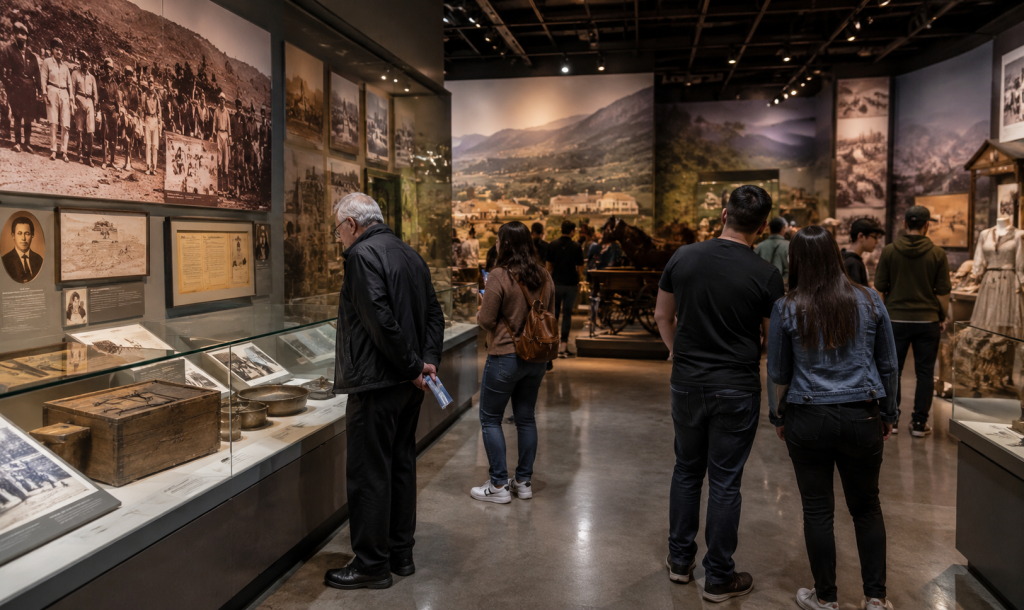
The Oakland Museum of California’s Gallery of California History connects subjects such as migration, activism, Native history, technology, and cultural change. This kind of interpretation treats history as a collection of intersecting experiences rather than one continuous story told from a single viewpoint.
The California Museum takes a similarly broad approach, using exhibitions to explore state history through communities, artifacts, art, oral history, and civic experiences.
For heritage travelers, that means 2026 is a strong year to visit museums, archives, historic parks, and local historical organizations. Many institutions are using the anniversary to revisit familiar stories and highlight material that has received less attention in the past.
Historic Places Make the Anniversary Tangible
Anniversaries are based on dates, but historic places make those dates easier to understand.
A Gold Rush town can reveal patterns of migration and commerce. A railroad station can explain how communities became connected. A historic farmworker site can illuminate labor history. A preserved Japantown building can tell a story about migration and displacement. A Native cultural landscape can place thousands of years of history within a physical setting.
Even twentieth-century roadside architecture belongs in this larger story because highways changed migration, tourism, suburban development, and commerce.
California’s heritage becomes richer when these places are viewed as connected rather than isolated attractions.
America at 250 Is a Starting Point Rather Than an Ending
The anniversary provides a useful moment to ask what Californians choose to preserve and what stories future generations may inherit.
Some historic places are carefully restored. Others disappear before their significance is widely recognized. Digital archives are making historical photographs and documents easier to access, while museums are reconsidering the language and perspectives used in exhibitions.
At the same time, tribal communities, local historians, preservation organizations, neighborhood groups, libraries, archives, and cultural institutions continue documenting histories that might otherwise be lost.
California Adds Complexity to the American Story
California’s place in America at 250 cannot be summarized by a single event. Its history reaches far before American independence and continues through colonization, Mexican governance, U.S. expansion, statehood, migration, industrialization, social movements, cultural innovation, and rapid modern change.
That complexity is precisely why California matters to the anniversary.
Looking at America from California makes the national story wider. It brings Native history, the Pacific world, migration, western expansion, environmental change, cultural exchange, transportation, agriculture, entertainment, and technology into the conversation.
In 2026, the most valuable way to approach America at 250 may not be to search for one perfect story about the past. It may be to explore the many stories that explain how California became what it is today and how those histories continue to shape the state.