Route 66 reaches its centennial in 2026, giving California travelers, historians, preservationists, and roadside culture enthusiasts a reason to look again at one of the most recognizable highways in American history. The California portion of the Mother Road crosses the Mojave Desert, passes through communities shaped by automobile travel, continues through the Los Angeles region, and reaches its celebrated western end near the Pacific Ocean.
The centennial is about more than nostalgia. It offers an opportunity to examine the businesses, buildings, landscapes, signs, communities, and travel traditions that grew around the highway. It also raises an important question for historic preservation: what parts of Route 66 can remain visible for another century?
Why 2026 Matters for California Route 66
Route 66 was established in 1926, making 2026 its 100th anniversary. According to the National Park Service, approximately 345 miles of the historic route are associated with California. The road entered the state through the Mojave Desert before continuing toward the Los Angeles basin and the Pacific.
The National Trust for Historic Preservation has highlighted California as a major part of the nationwide centennial celebration. Events, preservation programs, road trips, and community projects are drawing fresh attention to places that once served generations of motorists.
For California heritage enthusiasts, that renewed attention makes 2026 an ideal year to explore the road as a cultural landscape rather than simply a line on a map.
The Mojave Desert Was the California Gateway
For westbound travelers, the Mojave Desert created one of the most dramatic stretches of the journey. Communities including Needles, Goffs, Essex, Amboy, Ludlow, Newberry Springs, Daggett, and Barstow became part of the Route 66 experience.
Travel across this landscape could be difficult, especially before modern vehicles, air conditioning, and freeway services became common. Long distances, intense heat, mechanical problems, and limited services shaped the experience of early motorists. Gas stations, garages, cafes, motels, and roadside businesses therefore became essential parts of the road.
Many of those businesses disappeared after interstate highways redirected traffic. Others survived and became heritage destinations in their own right.
Roadside Businesses Became Part of the Heritage
One of the defining characteristics of Route 66 is that its history is not limited to pavement. The road created an entire environment designed around motorists.
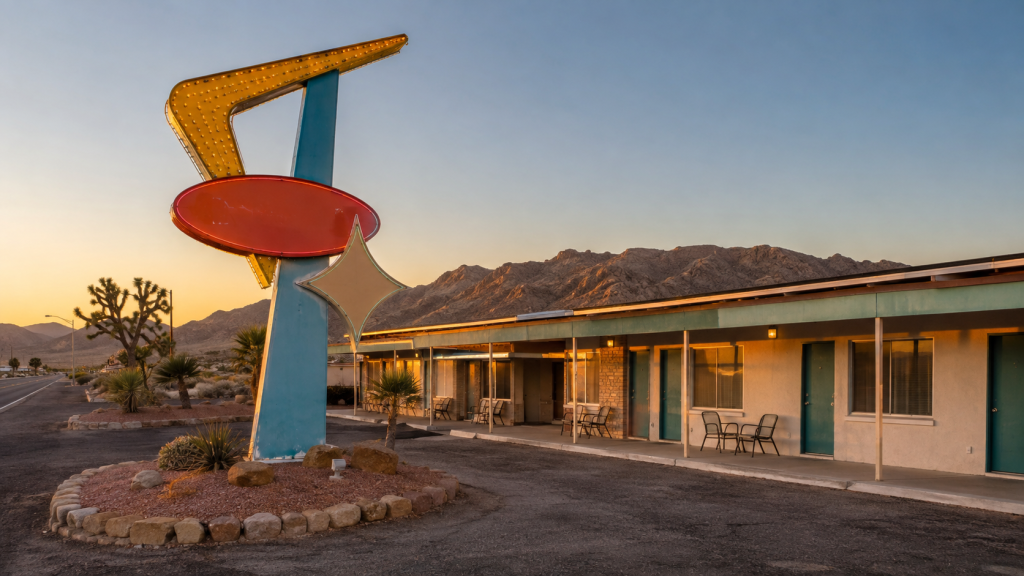
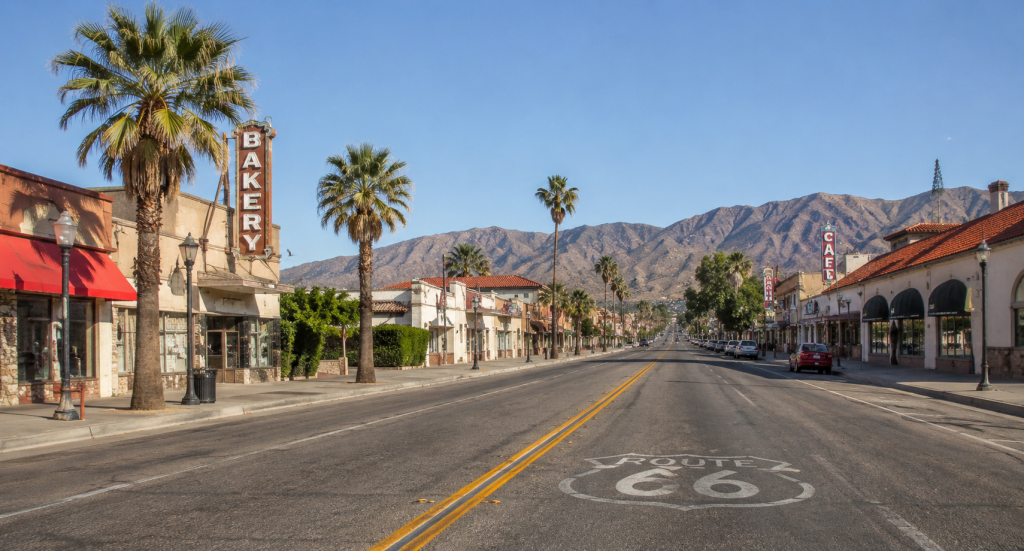
Restaurants advertised with oversized signs. Motels placed neon beside the highway. Service stations appeared at important junctions. Small businesses developed recognizable architecture intended to catch the attention of people traveling at automobile speed.
Today, these commercial places help explain the growth of twentieth-century automobile culture. A surviving cafe or motel may reveal just as much about the road as an original section of pavement.
The California Historic Route 66 Association works to promote awareness of the road’s California history and identifies communities and points of interest along the corridor. Its preservation work demonstrates how Route 66 remains connected to living businesses and communities rather than functioning only as a historic artifact.
Route 66 Helped Shape Southern California Travel
After leaving the Mojave, Route 66 crossed Cajon Pass and entered the rapidly developing communities of Southern California. Its historic alignments passed through places such as San Bernardino, Rancho Cucamonga, Claremont, Monrovia, Pasadena, Los Angeles, Hollywood, and Santa Monica.
As the metropolitan region expanded, the route became intertwined with local streets. That is one reason tracing Route 66 through greater Los Angeles can feel different from following a single rural highway. Historic alignments changed over time, and pieces of the old road became ordinary city streets surrounded by newer development.
This urban transformation is part of the story. Route 66 did not remain frozen in the 1930s or 1950s. It adapted to a region experiencing enormous population growth, suburban expansion, freeway construction, and changing transportation patterns.
The Road Became a Symbol of Migration
Route 66 is closely associated with people moving west during the twentieth century. During the Dust Bowl era, migrants traveled toward California searching for agricultural work and new opportunities. That history gave the road a place in literature, photography, music, and popular memory.
The California experience, however, was more complicated than the image of an open highway leading directly to prosperity. Migrants arriving in the state often encountered difficult working and living conditions. Communities along the route also experienced economic change as traffic patterns shifted.
Exploring these stories gives the Route 66 centennial greater depth. The highway represents mobility and possibility, but it also provides a way to examine migration, labor, tourism, business, and regional development.
Why Route 66 Preservation Is Still Active
Route 66 was removed from the federal highway system in 1985, but public interest continued. Preservation organizations began documenting historic properties, restoring signs, supporting local businesses, and protecting surviving sections of the corridor.
The National Park Service Route 66 Corridor Preservation Program has supported preservation, research, planning, and educational projects along the historic highway. The program reflects an important idea: the significance of Route 66 includes buildings, landscapes, businesses, communities, and stories as well as the road itself.
California properties associated with Route 66 have also been studied through National Register of Historic Places documentation for U.S. Highway 66 in California. Such records help explain why particular road segments and properties matter historically.
The Centennial Is Bringing New Attention to Old Places
The 100th anniversary has encouraged communities to revisit what remains along the corridor. Preservation organizations, museums, local businesses, and community groups are using the centennial to introduce travelers to historic sites that might otherwise be overlooked.
A small roadside restaurant, old sign, former gas station, desert settlement, historic theater, or motel may suddenly become part of a larger statewide and national story.
For travelers, the best way to experience historic Route 66 is often to slow down. Interstate highways are designed to move vehicles efficiently. Historic Route 66 rewards curiosity. Detours into old downtowns, roadside stops, surviving bridges, neon signs, and former alignments reveal the road’s character.
Route 66 Is Also a Story About California Architecture
Architecture along the Mother Road developed around visibility and convenience. Buildings had to communicate quickly with passing motorists. That encouraged bold signs, unusual shapes, roadside courts, service stations, diners, and motels designed around automobile access.
Some properties reflected Spanish Revival, Streamline Moderne, mid-century modern, or regional roadside styles. Others were simple commercial buildings that gained significance because of the businesses and communities they served.
This relationship between transportation and architecture is one reason Route 66 belongs within the broader story of California history and America’s 250th anniversary. The road shows how transportation technology changed everyday life, business, tourism, and the physical appearance of California communities.
Native History Is Part of the Landscape Too
The Route 66 story did not begin when pavement arrived. The Mojave Desert and Southern California landscapes crossed by the highway are ancestral homelands with histories extending far beyond twentieth-century automobile travel.
Modern heritage interpretation increasingly recognizes that roads, parks, historic sites, and cultural landscapes contain multiple layers of history. Readers interested in this broader approach can also explore our article about the California Indian Heritage Center taking shape in 2026.
Connecting these histories helps prevent Route 66 from being reduced to vintage cars and neon. The road passes through landscapes that carried meaning long before motorists arrived and continue to hold meaning today.
Planning a Heritage-Focused Route 66 Trip
A history-focused Route 66 trip works best when the journey is treated as the destination. Rather than trying to cover every mile quickly, travelers can select a region and explore its surviving historic places.
The National Park Service Route 66 travel resources provide background for people interested in historic sites along the corridor. The California Historic Route 66 Association also provides information about communities and preservation projects within the state.
Before traveling through desert areas, visitors should also consider current road conditions, weather, fuel availability, and the limited services found on some older alignments. Historic roads were created for different vehicles and traffic patterns than modern freeways.
What the Next Century Could Mean for the Mother Road
Route 66 has already survived one major transformation. It went from an important cross-country highway to a decommissioned road and then became one of the country’s best-known heritage routes.
The next challenge is maintaining the physical places that make that history visible. Historic motels need viable uses. Neon signs require maintenance. Desert structures face severe environmental conditions. Old road segments compete with modern transportation needs. Small communities need economic activity that supports preservation without erasing local character.
The centennial provides an opportunity to think about those issues while celebrating what remains.
California Route 66 Is Still a Living Story
One hundred years after Route 66 was established, the California section continues to connect transportation history, migration, architecture, tourism, preservation, and community identity.
The Mother Road survives because people still use it, study it, photograph it, restore it, operate businesses along it, and tell stories about the people who traveled before them.
In 2026, the centennial is giving California another reason to look closely at the highway. The most meaningful way to celebrate may be simple: leave the interstate when conditions allow, explore an old alignment, support a historic roadside business, learn the story of a community, and notice what remains beside the road.